

Things to do in Kosice
Things to Do in Košice: Complete Travel Guide to Slovakia’s Eastern Gem
Košice, the second-largest city in Slovakia, lies in the picturesque valley of the Hornád River. Often overlooked by travelers, the metropolis of Eastern Slovakia is a true hidden gem for a city break. With its beautifully preserved Old Town, rich medieval heritage, and vibrant cultural scene, Košice surprises visitors with far more than they ever expect.
Whether you are visiting for a short city break or using Košice as a gateway to eastern Slovakia, this guide covers the very best things to do in Košice. Locals are called ‘Vyhodňare’, and people from eastern Slovakia are known for being warm-hearted and generous. We highly recommend you to get know them. The city stands at a crossroads between East and West, as well as between Roman Catholics, Greek Catholics, and the Orthodox. Many Slovaks thinks, that Košice are more beautiful than Bratislava. What makes Košice truly special is its Main Street, which is especially lively in summer, filled with the terraces of restaurants and bars.
Košice is also a city of sport. The International Peace Marathon, the oldest marathon in Europe, is the city’s most important sporting event. It takes place every year on the first Sunday of October and is the second-oldest marathon in the world, after the Boston Marathon.
Ice hockey and football are also very popular in Košice. The local ice hockey team, HC Košice, is one of the most successful clubs in Slovakia. Playing their home matches at the Steel Arena, the team is famous for its outstanding atmosphere. If you are visiting Košice in autumn, winter, or early spring, we highly recommend attending a hockey match.
The main engine of Košice’s economy has long been the iron and steel works, originally known as VSŽ and now part of U.S. Steel. From 2026, Košice will also host a Volvo plant producing electric cars. In addition, one of Slovakia’s largest startups, GymBeam, is based in Košice, and the city has a strong and growing IT sector
A short history of Košice
The presence of a Slavonic community settled here in 8th century. The first written notice about Košice is from 1216. The boost for development of the city was arrival of German colonists. The German incomers appeared immediately after the Tartar invasions new inhabitants. The Saxons who settled in Košice achieved religious self-government very early, and in 1290 they were exempted from the jurisdiction of the archdeacon. Already by that time, the original, one-nave church of Saint Elizabeth (1260) stood already in the city.
By the end of 13th century markets were held in the town, which emerged as an important center for the barter of imported goods from Prussia. The city of Košice as an ally of the Hungarian King Charles Rober of Anjou got charter of a Free Royal Town in 1342, as one of the first Slovak towns. By mid 14th century Košice had only one rival in the Hungarian kingdom – the capital city Buda. The kings favoured the city and paid the city frequent visits and stays. The imposing appearance of Gothic Košice was equal to its importance.
Košice did not escape the religious wars during Reformation and Counter-Reformation. The churches, including Saint Elisabeth Cathedral changed hands several times. The religious unrest, the pressure of the Turkish armies, the rebellions of the Hungarian Estates as well as the loss of the leadership of south-north commerce after the shift of world trade centers westwards caused a slump both in commerce and craft production in the city.
At the turn of 19th century the economy revived. Manufacture producing English porcelain, hats and cloths appeared in the town. The population was constantly rising, especially owing to influx of people from villages. The arrival of the railways, which connected Košice to Miskolcz and Budapest in 1860, and to Bohumin in 1870, provided a new mighty impulse for economic boom of the town.
Košice has always been a cosmopolitan city. A mixture of the Slovaks, Hungarians, Germans and a significant Jewish minority. At the beginning of 1919, the city became part of the first Czecho-Slovakia. During the Second World War Košice was annexed by the Hungarian regime. At the beginning of 1945 the city became of one of the first liberated cities of Czecho-Slovakia. For a while it also became the political center of renewed Czecho-Slovakia and the Košice government program – “Košický vládny program” was declared in the city.
Košice Main Highlights
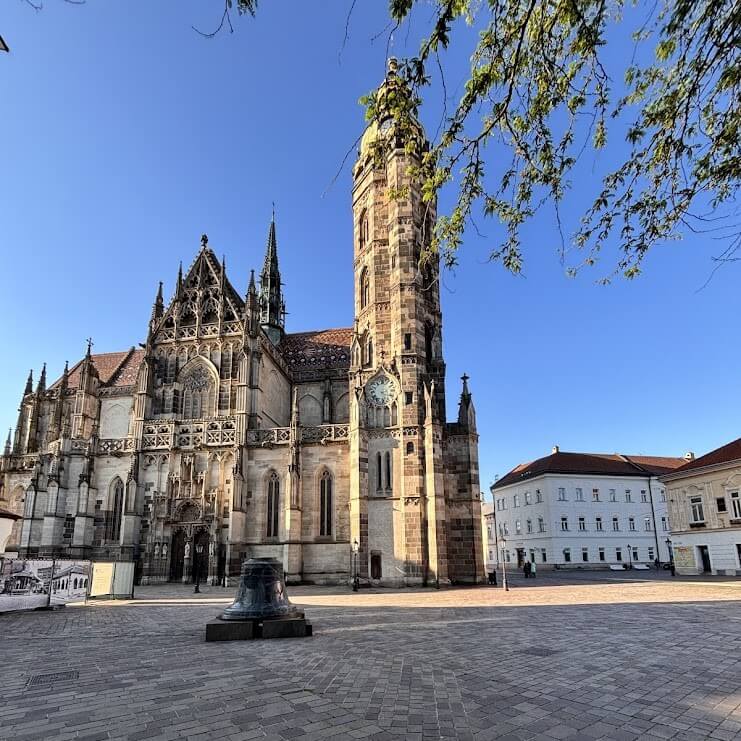
The complex of the Cathedral of Saint Elisabeth
A National Cultural Monument, the most eastward located gothic cathedral in Europe. It consists of the cathedral, the chapel Saint Michael and Saint Urban tower. The cathedral was built at the end of the 14th century. The last major reconstruction began in 1877, when cathedral got its present look as the five nave cathedral. In 1906 was built the crypt of Ferencz Rákoczy II, the leader of one of the rebellions against Habsburg royal family. His remains were buried in the crypt. The cathedral of Saint Elisabeth is the biggest church located in Slovakia. The area of cathedral is 1 796 m² and capacity approximately 5000 people.
The chapel of Saint Michael, situated south of the cathedral is a part of complex, build towards the end of the fourteenth century as a funerary chapel in a churchyard. The chapel now serves mainly for the weddings and every Sunday is celebrated here the holy mass in English. Saint Urban’s Tower, a detached medieval bell tower from 14th century also belongs to the cathedral complex, all of which was originally surrounded by a churchyard wall until nineteen century.
📅 Opening Hours:
Summer season (May – September)
Monday – Saturday: 09:00 am – 02:45 pm & 03:45 pm – 05:30 pm
Winter season (October – April)
Monday – Saturday: 10:00 am – 02:45 pm, 03:45 pm – 05:30 pm
💰Entrance fee: € 6 per person
The State Theatre
Built in the middle of the square in a park according to the design in historicizing style by A.A. Lang and Steinhardt at the end of 19th century. The auditorium ceiling-painting is by P. Gastgeb.
The Jesuitical Monastery and the University Church
The church was built in 1671-1784 after the Gesu in Rome by Vignola. The front façade made of hewn stone combines both monumentality and tranquillity which are emphasized in the centre by the entrance portal and two towers. The monastery was built for use of so-called Royal House after 1654. Košice University resided in the building, and later the Jesuitical painting house was located there as well. There was also a High School founded by the Premonstratensians, the new owners of the complex, in 1811. The academy of law was re-established here in 1894-1904. There are stucco vaults in the rooms situated on the ground and first floors.
The Franciscan Monastery and Church
Originally a Gothic structure from 14th century. Located on the northeast edge of the city next to the walls, it was later incorporated into a row of houses on the spindle-shaped square. The ground-plan reflects the type of construction favoured by the friars.
The Franciscan left Košice after the fire; the provisional vaulted monastery was given to the army by the Royal Chamber.
The present-day building dates back to 1764. It was transformed to the classical style for the needs of the Seminary.
Levoča House
Late-Gothic two-storeyed corner house with a passageway was a donation to the town of Levoča by Alexis Thurzo in 1542. Košice’s City Council bought the house in 1569 and it was turned into an inn. In 17th century the Renaissance arcades in the courtyard were added during reconstruction. Late in 18th century the house was remodelled into the Baroque style, and later it was Gothicized in 1908. The rooms are covered with extremely boldly constructed Gothic rib vaults. In the Levoča House is located the oldest Slovak pub, which has been open since the 17th century.
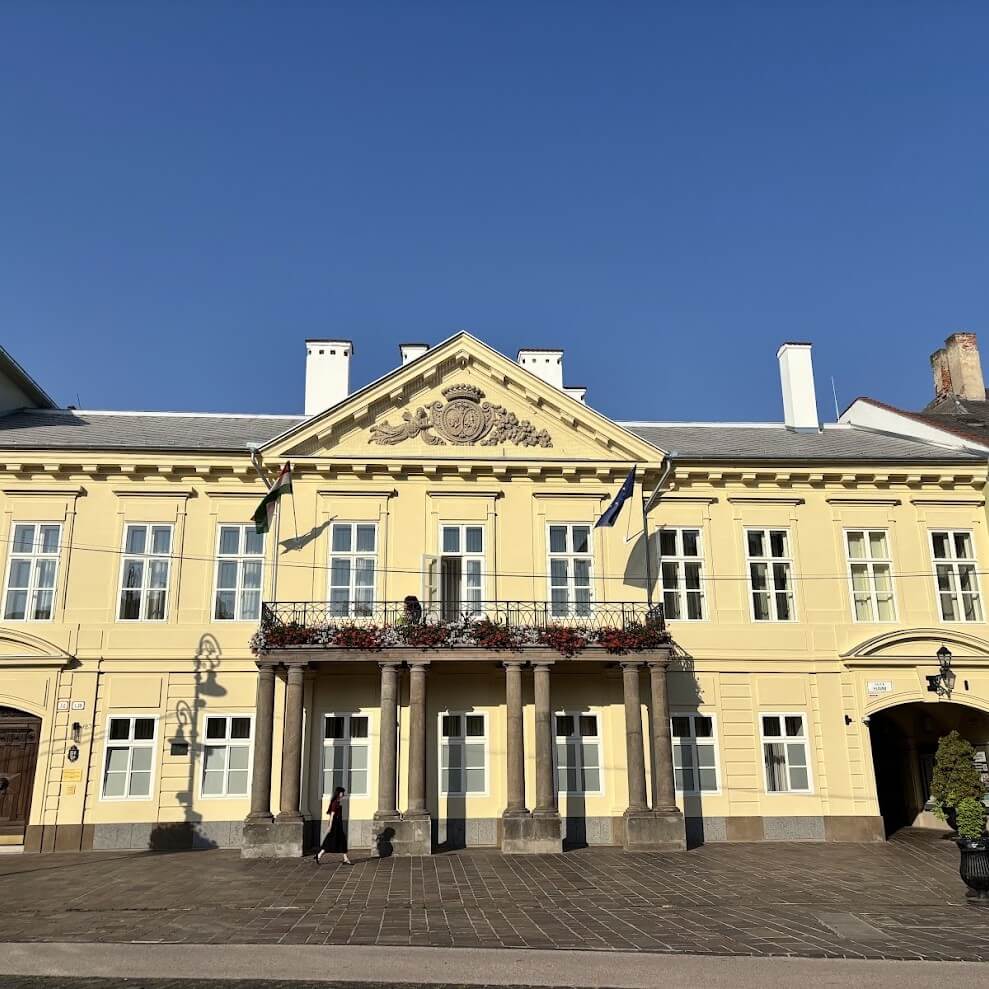
Csaky Palace
Also known as the Dessewffy Palace, this Classicist three-storey palace dates from the beginning of the 19th century and was considered the most comfortable palace in the town. The Russian Tsar Alexander I was also accommodated here during his stay in Košice. Now the Csaky Palace is premises of Slovak Constitutional Court.
The Eastern-Slovakia Museum
A majestic edifice of neo-Renaissance architectural expression, built in 1899-1901. Exhibitions on eastern-Slovakia regional development, numismatic collections, and the Gold Treasure of Košice. Hoard of gold coins and other gold objects are located here. Mikluš Prison and the Hangman’s Bastion also belong to the museum.
📅 Opening Hours:
Summer season (April – October)
Tuesday – Sunday: 09:00 am – 05:00 pm
Winter season (November – March)
Tuesday – Saturday: 09:00 am – 05:00 pm
💰Entrance fee: € 6 per person
Mikluš Prison
Originating in 17th century, it is composed of two burgher’s houses from 15th century. The original house situated on the left hand two storeys and was illuminated through large Gothic windows. Only fragments of this house remain. The house situated on the right was one-storeyed, and raised by one floor in the second half of 15th century. The prison was referred to in 1618.
Structurally, the building was adapted to the needs of a prison. After the reconstruction in 1940-1942, the exposition of the town’s history was located here.
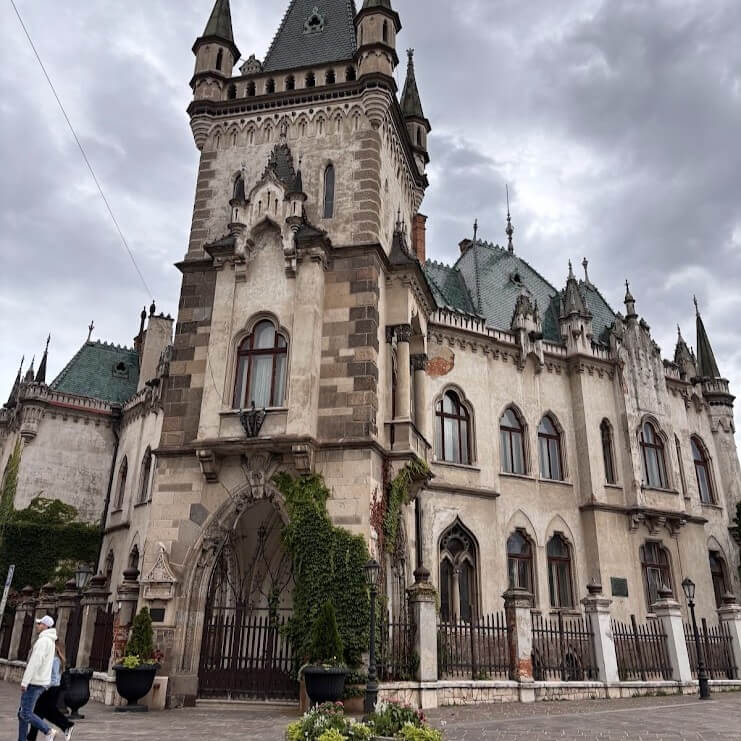
Jakab Palace
Located next to a former mill-race, the palace was built by Jakab, the architect of many Art Nouveau and Romantic buildings. He used rejected stone elements from renovated Saint Elizabeth’s for the construction of this palace at the end of 19th century. In 1945, Jakab Palace hosted Edvard Beneš, President of Czechoslovakia, during a key moment in the country’s post-war history. Unfortunately, the palace is currently closed due to an ongoing legal dispute.
The Coat of Arms of Košice
The coat of arms of Košice are incontestably the most remarkable in Slovakia. Their uniqueness lies especially in that Košice acquired the letters pattent for the coat of arms in 1369, which is the oldest one in all all of Europe. Moreover, the city was the only Hungarian city that received four letters patents within 133 years. At present the City Council favours the earliest design of the arms, from 1502.
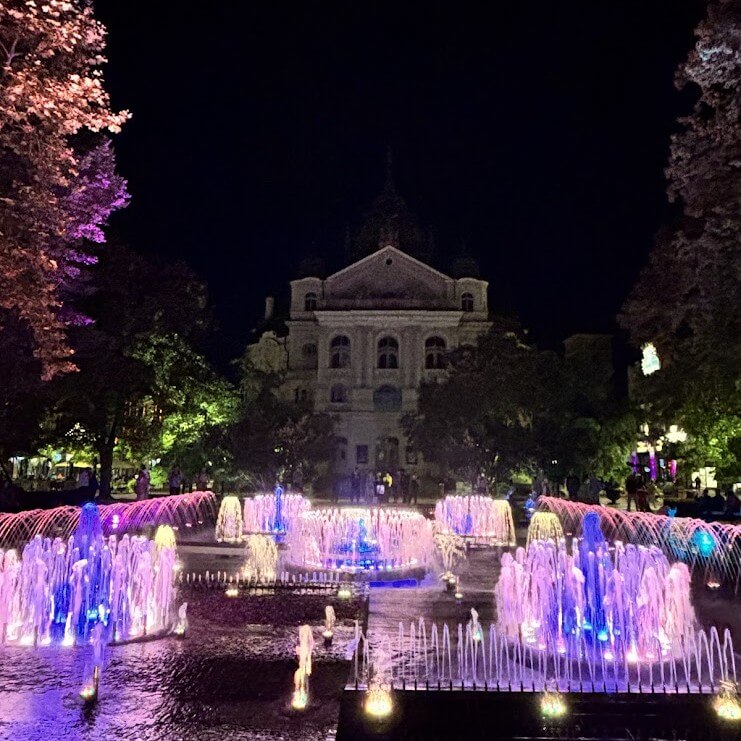
Singing fountain of Košice
Immerse yourself in Slovak and international evergreens right in the heart of Main Street in Košice. Located next to the State Theatre, one of the city’s most popular attractions is the Singing Fountain, whose repertoire includes more than 100 songs.
📅 Season: April – October
🕐 Shows: from 10:00 am till 10:00 pm
💰 Free to watch
💡 Tip: Grab ice cream from nearby and enjoy the show from the theatre steps
The most famous native of Košice – Sándor Márai
One of the most famous natives of Košice is undoubtedly Sándor Márai. About his significance to the city testify one saying: “What it is for Prague Kafka, it is for Košice Sándor Márai”. No surprise, Sandor Márai is one of the most translated authors. His novels were translated into more than 40 languages. Sandor Márai has also his statue and museum in Košice.
💰 Entrance fee: €6
📅 Opening hours: Tue–Sun 9:00 am – 05:00 pm (last entry at 04:00 pm)
Where to stay in Košice
Here are our suggested hotels in Košice:
DoubleTree by Hilton, 4* Košice -> the best and biggest four star hotel of the city.
Hotel Yasmin, 4* Košice -> the best hotel as regards quality=price
Hotel Gloria Palace, 3* Košice -> a good three star hotel, located close to Aupark shopping mall and train station.
Hotel Teledom, 3* Košice -> a good 3* hotel.
Where to eat in Košice
To eat we recommend you these restaurants in Košice:
Karzma Mlyn -> offers traditional eastern Slovak cuisine. We recommend trying the local specialty, tatarče pirohy.”
Cafe Slávia -> A legendary café in Košice, part of the Boutique Hotel Slavia. It is the city’s most luxurious restaurant, offering refined traditional Slovak cuisine.
Arthur Gelato -> Slovakia is a country of ice cream lovers. The best ice cream in town can be found on Hlavná Street at Arthur Gelato.
How to get to Košice
✈️ By plane:
Košice has its own international airport with several direct regular flights within Europe.
- Bratislava – operated by Wizzair
- Liverpool – operated by Ryanair
- London – operated by Ryanair
- Vienna – operated by Austrian Airlines
- Warsaw – operated by LOT
- Zurich – operated by SWISS
🚆By Train:
There are several trains between Bratislava and Košice or vice versa. The train departs from Bratislava/ Košice every hour and the the journey takes about 5 hours 20 minutes. Operated by Slovak Railways.
💰The train ticket cost about €19-20 per person
A direct train runs every two hours between Košice and Budapest, arriving at Budapest Keleti station in just four hours.
💰The train ticket cost about €24-25 per person
🚗By Car:
You can get from Bratislava to Košice also by car. There are three options how to get there.
- The northern route via the D1 highway. The journey takes about 4 hours 25 minutes and it is 452 km long.
- The southern route via the R1 and R2 highwas almost to Lučenec and from there to 1st class road to Košice. The journey takes about 4 hours 18 minutes and it is 404 km long.
- The combined route of R1 and D1 passing through mountain pass Donovaly. The journey takes about 4 hours 25 minutes and it is 449 km long.
FAQ: Visiting Košice – Practical Questions Answered
❓ Is Košice worth visiting?
Absolutely. Košice is one of Slovakia’s most underrated cities. With the largest Gothic cathedral in the country, a beautifully walkable Old Town, and a lively cultural scene, it’s perfect for a city break or as a base for exploring eastern Slovakia.
❓ How many days do I need in Košice?
Two days are ideal to explore the Old Town and main sights at a relaxed pace. With three or more days, you can add museums, cafés, and day trips to the surrounding region.
❓ What is Košice most famous for?
Košice is best known for:
- Saint Elisabeth Cathedral (the largest church in Slovakia)
- One of Europe’s oldest city coats of arms
- A rich medieval and multicultural history
- Being the cultural capital of eastern Slovakia
❓ Is Košice a good destination for history lovers?
Yes. Košice has a long and complex history influenced by Slovaks, Hungarians, Germans, and Jews. Visitors can explore Gothic, Renaissance, Baroque, Classicist, and Art Nouveau architecture all within the Old Town.
❓ Can I visit Saint Elisabeth Cathedral inside?
Yes. The cathedral is open to visitors most days, except during religious services. You can admire its impressive interior, Gothic vaults, and the crypt of Ferenc Rákóczi II.
❓ Are there guided tours available in Košice?
Yes. Guided walking tours are available and highly recommended, especially if you want to understand the city’s layered history, legends, and architectural details that are easy to miss on your own.
❓ What makes Košice different from Bratislava?
Košice feels more relaxed and less touristy. While Bratislava is closer to Vienna and Budapest, Košice offers a deeper medieval atmosphere, a compact Old Town, and a strong local character.
❓ Is Košice suitable for a weekend city break?
Definitely. Košice is compact, easy to explore on foot, and offers a good mix of sightseeing, cafés, culture, and nightlife—ideal for a long weekend.
❓ What are the must-see buildings in Košice?
Don’t miss:
- Cathedral of Saint Elisabeth
- Saint Michael’s Chapel
- State Theatre
- Jakab Palace
- Levoča House with the oldest pub in Slovakia
- Mikluš Prison
❓ Does Košice have any royal or political history?
Yes. The city hosted important historical figures, including the Russian Tsar Alexander I and Czechoslovak President Edvard Beneš. In 1945, Košice briefly became the political center of renewed Czechoslovakia.
❓ Is Košice expensive for tourists?
No. Compared to Western European cities, Košice is very affordable. Accommodation, food, and entrance fees are reasonably priced, making it great value for money.
❓ Where is the best area to stay in Košice?
Staying near the Old Town is the most convenient. Hotels around Hlavná Street allow easy access to all major sights, restaurants, and cultural venues.
❓ Is Košice good for first-time visitors to Slovakia?
Yes. Košice offers an authentic Slovak experience without crowds, making it an excellent introduction to the country—especially for travelers interested in history and culture.
❓ Is Košice a safe city?
Yes. Košice is a safe city, although a large gypsy community live there.
Planning a group in Slovakia or Central Europe?
e-travel is an incoming DMC in Bratislava — send us the group, the dates and the cities, and we come back with a tailored proposal at net rates.